The Past Two Years
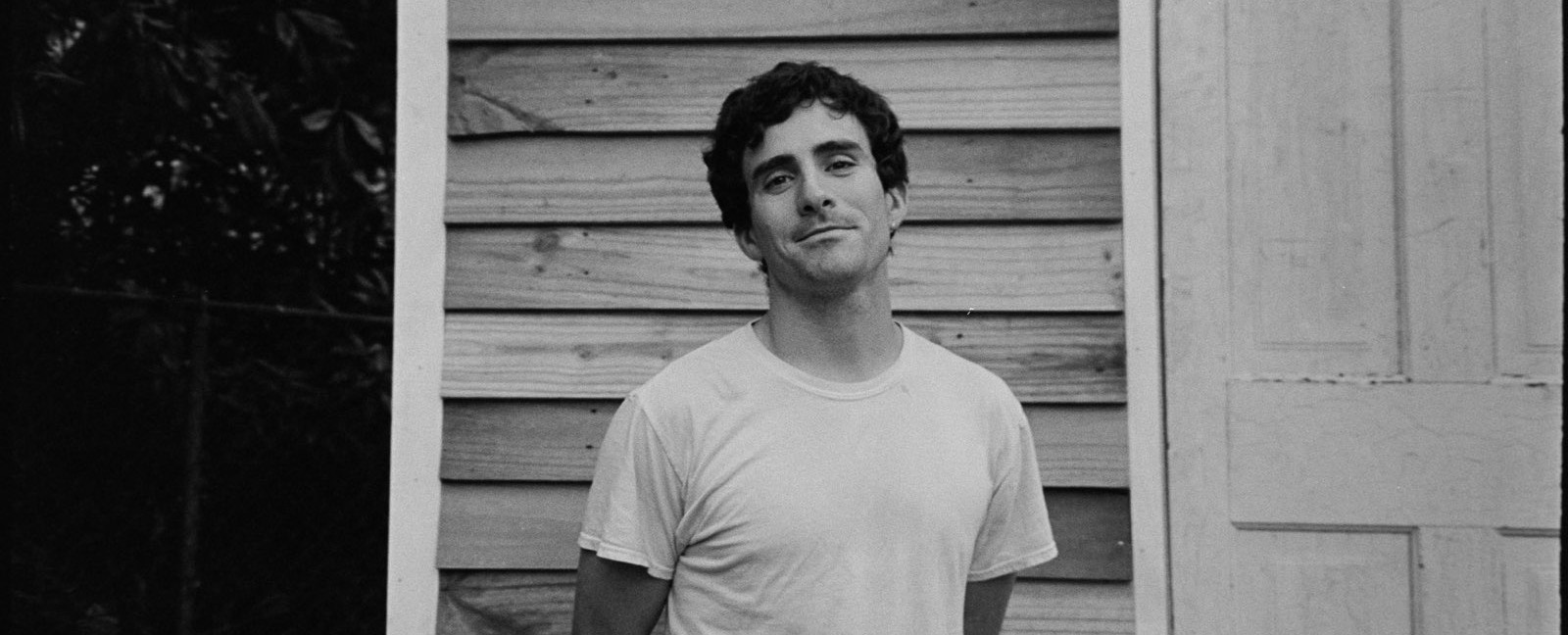
Today, March 2, 2026, Jack’s case finally concluded after a long two years. Jack took a non-cooperating plea deal under Alford which allows him to maintain his innocence while accepting conviction. He plead to one count of criminal damage to property in the first degree. Judge Richardson sentenced Jack to ten years probation minus 53 days (time he served in jail), and 300 hours of community service. In 60 days he will have a restitution hearing. He is banned from a community center for one year. Jack was subjected to a waiver of his Fourth Amendment rights for the duration of his 10-year probation. The Fourth Amendment protects against unreasonable search and seizure by police or government agents, meaning Jack cannot invoke this right during his probation term. Jack’s sentence also included a broad ban on “anti-government group activities” or participating in any group activity “outwardly proclaiming anti-government sentiments” — essentially, a ban on participating in protest. It’s clear this effectively constitutes a waiver of his First Amendment rights to free speech, association and assembly as well.
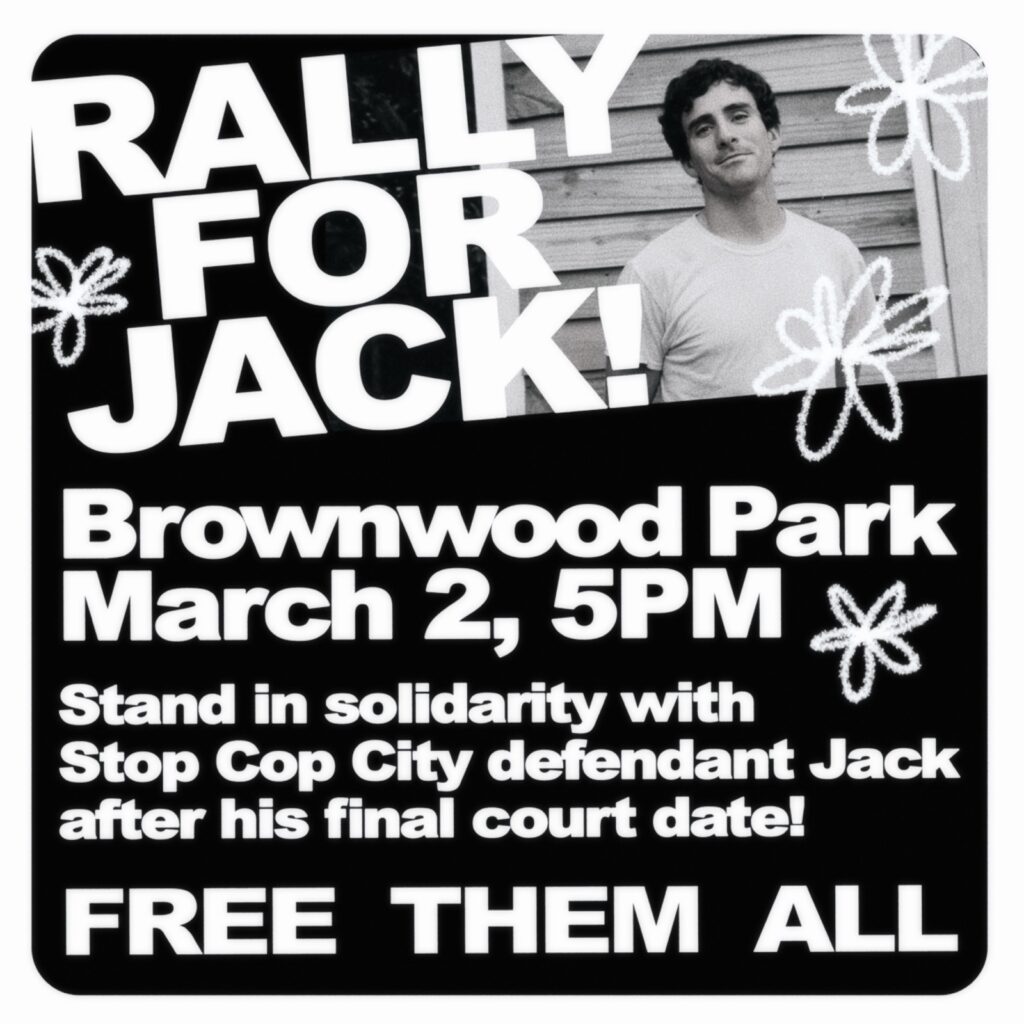
There will be a solidarity rally organized by community members tonight at 5 pm. Jack will give a statement to friends and supporters. There will be food and music.
The following is an overview and summary of Jack’s experience and the progress of the case, written by his support crew.
On February 8, 2024, the Georgia and Federal Bureaus of Investigation, Atlanta Police, and the ATF raided Jack’s home and arrested him on one count of Arson. Six months earlier, on July 1, 2023, during the sixth Week of Action of the Stop Cop City movement, anonymous activists burned several motorcycles at the Atlanta police training facility. The State alleged that investigators found Jack’s DNA on the cap of a two-liter bottle containing flammable material at the scene.
The magistrate court denied Jack bond the day after his arrest. He then spent nearly two months behind bars. He spent one month at Fulton County Jail, a notoriously dysfunctional and unsanitary facility. During that time, hackers compromised the government’s computer systems, slowing inmate processing, including commissary access—Jack’s lifeline to edible food. The jail refused him vegan or vegetarian meals for his entire stay, despite his submitting all required forms and repeatedly meeting with the jail chaplain. His lawyer visited, and friends called on his behalf. Jack experienced severe malnourishment and continuous harassment at Fulton County Jail, a common experience for detainees there. Correctional officers threatened to “pop” him. One officer pointed her taser at him when he asserted his right to adequate food.
After a month, authorities transferred Jack to Cobb County Jail. Fulton County contracts with Cobb to house some inmates; officials routinely squander, steal, or waste funding for Fulton County Jail, leaving facilities unfit. It is plausible that officials transferred Jack to avoid mounting pressure from his friends and support network about his conditions. At Cobb, he gained access to vegetarian food but remained locked down most of the day, leaving his cell only for short periods.
The court scheduled Jack’s arraignment and a second bond hearing for March 4, 2024. Friends gathered outside the courthouse with supportive banners, and a hardcore band played on the sidewalk. Minutes before the hearing, the court informed Jack’s lawyer that the State had indicted him and canceled the hearing. Authorities sent Jack back to the Fulton County Jail on Rice Street. Hundreds of letters poured in from friends and supporters.
The court rescheduled his bond hearing for March 29, 2024, over Zoom. More than 150 supporters attended virtually. Five witnesses testified on Jack’s behalf, and supporters submitted letters and statements to the judge. The State argued that Jack posed a flight risk, citing a trip they claimed he took to Chiapas, Mexico, the previous winter. Prosecutors also relied heavily on journal entries they claimed to have seized during the raid.
The judge rejected the State’s arguments and granted Jack bond, though with heavy restrictions. The court set bond at $75,000 and required 24/7 electronic monitoring. The judge also ordered him to have no contact with “members of the Defend the Atlanta Forest movement” and barred him from using social media. Jack was released on the morning of March 31, 2024, and his loved ones warmly welcomed him home.
Over the next several months, the court gradually allowed Jack to leave the house for work. Eventually, the judge extended his curfew, though he remained on 24/7 monitoring and submitted to check-ins and drug tests, all of which he passed. For nearly two years, Jack fully complied with the conditions of his bond as the case dragged on.
On November 7, 2024—nine months after his initial arrest—the DA brought new charges, alleging that illegal mushrooms were found on his property during the February raid. Jack turned himself in to the Rice Street jail and bailed out the following morning. As part of Jack’s plea deal, the State agreed to drop these charges. His support committee noted the irony, as Jack has been sober for well over a decade.
Between his release on March 31, 2024, and January 2025, the court held three motions hearings to determine what evidence the State could admit. Prosecutors moved to include information about Jack’s alleged connection to the Zapatistas, including what they claimed was evidence that he participated in a play about the Stop Cop City movement while in Chiapas in late 2023—several months after the motorcycles were burned.
The State also sought to admit a photo of Jack taken at an Atlanta City Council hearing and later published in the New York Times. At that hearing, the City ignored several hours of public comment opposing the Cop City project and approved funding. Hundreds of community members attended. Prosecutors also moved to submit Jack’s phone records, arguing that his lack of phone use at the time the motorcycles were burned indicated guilt. Jack’s lawyer argued that this evidence was irrelevant to the arson charge. The State’s case relied heavily on the logic that any political speech or activity could serve as evidence. The judge said she would rule on these motions by the end of 2024, but as of this writing, she has not issued any rulings.
As the case crawled through the court system, Jack and members of his community faced surveillance and threats of violence. In May 2024, Jack and his roommates woke in the middle of the night to a road flare lit on their porch. Someone installed hidden surveillance cameras on the road outside their home and at other locations. Police regularly parked in front of Jack’s house and turned on their sirens in the middle of the night.
Jack’s support crew maintains that this case forms part of the State’s broader attempt to repress activism related to the Stop Cop City movement. The RICO case against 61 protestors fell apart in the fall of 2025, though appeals remain pending.
Despite the uncertainty of this repressive case and the ongoing surveillance and threats, Jack and his community have remained strong and steadfast in their commitments to one another. In the summer of 2025, Jack and his partner welcomed their first child, an amazing baby boy. Jack has remained active—rock climbing, training Jiu Jitsu, weight lifting, and meditating. When the judge has allowed him to travel, he has spent time with friends and family, including his two young nieces.
In 2025, the State made clear its interest in reaching a deal with Jack and his lawyer. We maintain that the State’s willingness to do so reflects the weakness of its initial case and its recognition that it would have lost at trial. It has been a long and arduous two years, but Jack’s case demonstrates the power of steadfast community support for political defendants. This deal is a positive outcome for Jack and his young family. Any positive outcome for a defendant is a win for the movement as a whole.
We believe that vulnerability and support are integral parts of the human condition. In this way, solidarity brings us closer to ourselves, just as it does the people we love. Moving through repression is never easy, but it can be meaningful and life-affirming work. While we are excited to be closing this chapter of legal vulnerability, we are extremely proud of Jack — as well as everyone who pitched in, refused to cooperate, and continues to resist state violence. Repression is inevitable, but it is also an opportunity to move with bravery, strengthen bonds, and stand for the things we believe.
Thank you for your support over the last two years. Every solidarity banner, photo, letter, and fundraiser meant more to us than we can say. When we fight together, we win. Solidarity with all those facing political repression.